
In 2026, a "cheap" quote for moving a 30-tonne excavator is usually just a down payment on a three-day permit delay. You know the drill. You have a site start scheduled for Monday morning, but your gear is stuck at a weighbridge because a contractor botched the route planning or went radio silent over the weekend. Finding a reliable heavy haulage contractor isn't just about who owns the biggest low-loader; it's about who actually understands the 2026 Master Code and the updated HVNL safety standards that came into effect this August.
We agree that you shouldn't have to babysit your logistics partner or deal with hidden costs for pilot vehicles. This guide provides a no-nonsense checklist to vet your transport partners so your machinery arrives on site without delays or permit dramas. We will break down how to secure fixed-price logistics, manage the new "unfit to drive" duty requirements, and ensure your contractor handles the heavy lifting before the wheels even start turning. It's time to stop gambling with your project timelines and start moving gear with precision.
Key Takeaways
- Demand 24/7 operational capability to ensure your gear moves when the site is ready, not just when it suits the driver's schedule.
- Learn why in-house NHVR permit coordination is the only way to avoid the red-tape delays that stall site starts in 2026.
- Match your machinery to the right fleet, from heavy low-loaders for 20-tonne excavators to rapid-response tilt-trays for smaller plant.
- Identify a reliable heavy haulage contractor by their ability to manage complex route planning and pilot vehicles without being babysat.
- Protect your project's cash flow by partnering with a provider that offers transparent logistics pricing and 15-day credit accounts.
The Ultimate Reliability Checklist: What to Demand from a Haulage Partner
Choosing a reliable heavy haulage contractor is the difference between a site starting on time and a crew standing around at $200 an hour. Reliability isn't a vague promise; it's a mechanical reality. In the high-stakes world of NSW construction, you need a partner who treats your timeline like their own. If your gear isn't on the ground when the sun comes up, you're losing money. Use this checklist to separate the experts from the amateurs before you sign a subbie agreement.
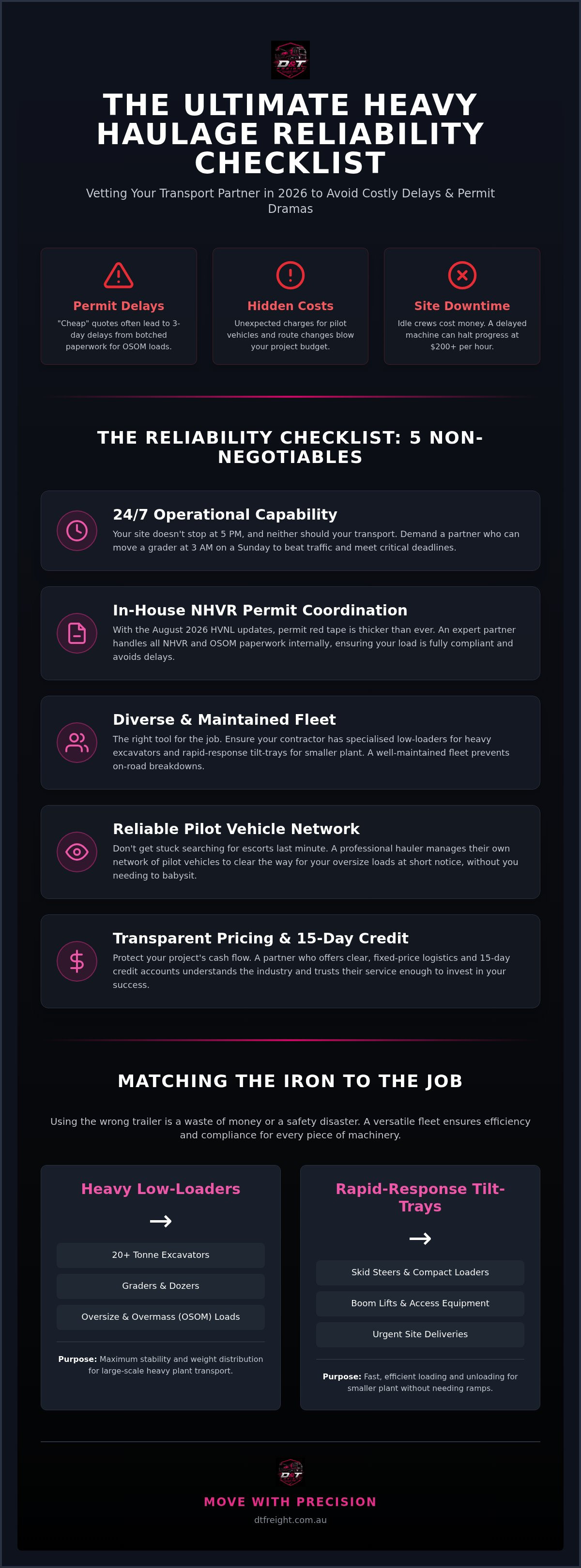
- 24/7 Operational Capability: Does their dispatch office go dark at 5 PM? If you need a grader moved at 3 AM on a Sunday to beat Sydney traffic, they must be awake and ready to move.
- In-House Permit Coordination: With the August 2026 HVNL amendments, the red tape is thicker than ever. A pro handles all NHVR paperwork and OSOM permits so you don't have to.
- Fleet Diversity: Ensure they have the right equipment for the job. A professional heavy hauler uses specialised low-loaders for 20-tonne excavators and tilt-trays for rapid site deliveries.
- Pilot Vehicle Network: Don't get stuck searching for escorts. Your contractor should have a reliable network of pilot vehicles to clear the way at short notice.
- 15-Day Credit Accounts: Site cash flow is tight. A partner offering credit terms shows they understand the industrial cycle and trust their service.
The "Get It Done" Factor
Look for a team that speaks your language. You don't need corporate jargon; you need a "get it done" attitude. Check their track record on the East Coast. If they've moved heavy plant through the tight streets of Sydney or up the Pacific Highway, they know the terrain. Ask about their response time for urgent moves. A reliable heavy haulage contractor doesn't flinch when a site start gets moved forward 24 hours. They adjust and execute.
Vetting the Logistics Expertise
Route planning in NSW is a minefield of low bridges and weight-restricted zones. Ask how they plan for OSOM loads. They should already know the bottlenecks. They must provide point-to-point tracking for high-value machinery. You shouldn't have to wonder where your $400,000 excavator is. Real-time data and direct communication with the driver are non-negotiable. If they can't handle the route planning without being babysat, they aren't the partner you need.
Assessing Fleet Versatility: From Tilt-Trays to Heavy Low-Loaders
A reliable heavy haulage contractor doesn't just show up with a trailer and hope for the best. They match the iron to the job. Using a massive quad-axle low-loader for a small skid steer is a waste of your project budget. Conversely, trying to squeeze a 20-tonne excavator onto a trailer that is barely legal is a safety disaster. Versatility means having the right deck for every piece of plant on your site list. It is about efficiency and moving gear without over-speccing the transport.
Maintenance is the silent killer of project timelines. A truck that breaks down on the Pacific Highway isn't just a mechanical failure; it's a breach of the Heavy Vehicle National Law regarding roadworthiness. Under the 2026 Master Code, your contractor's Safety Management System (SMS) must be auditable. This includes documented maintenance for every trailer and prime mover. You need a partner whose fleet is serviced to a standard that prevents on-road failures before they happen. If the gear isn't maintained, the delivery won't be made.
Choosing the Right Trailer for Your Plant
Low-loaders are the backbone for heavy plant like graders and large excavators. They provide the low centre of gravity and weight distribution needed for oversize loads. For smaller gear like boom lifts or compact earthmovers, tilt-tray trucks offer rapid site delivery without the need for complex loading ramps. To get the full breakdown on matching your machinery to the right transport, check out our guide on Moving Heavy Equipment: A Site Manager’s Guide to Heavy Haulage. Getting the trailer choice right the first time keeps your costs fixed and your schedule intact.
The Importance of Specialised Gear
General freight carriers often fail at machinery transport because they treat a 20-tonne excavator like a pallet of bricks. Heavy haulage requires technical equipment that general carriers don't carry. Out-of-gauge (OOG) trailers are essential for wide loads that exceed standard lane widths. Securing these loads isn't a task for amateurs. It requires heavy-duty chains, load tensioners, and site-specific safety gear to ensure nothing shifts during transit. When you need a fleet that is ready to roll, view our specialised haulage equipment to see how we handle the heavy lifting for NSW projects.
Navigating Permits and Compliance: Ensuring Your Load Stays Legal
Permits are the invisible bottleneck of heavy haulage. If your contractor is still "waiting on the portal" while your crew sits idle on a Monday morning, you have hired the wrong team. A reliable heavy haulage contractor treats permit coordination as a core operation, not an after-thought. Since the Heavy Vehicle National Law (HVNL) amendments took effect in August 2026, the stakes for compliance have never been higher. Fines for Chain of Responsibility breaches can now reach $10,000 for contractors who fail to ensure driver compliance, making a "she'll be right" attitude a massive financial risk for your business.
Oversize and Over Mass (OSOM) requirements in New South Wales are strictly enforced to protect infrastructure. Moving a 20-tonne excavator or a wide-track grader requires specific NHVR approvals that account for the latest axle mass limits. As of August 2026, tandem axle groups are capped at 17.0 tonnes and tri-axle groups at 21.0 tonnes. If your contractor doesn't know these numbers off the top of their head, they shouldn't be loading your gear. Pilot vehicles are another non-negotiable detail. Depending on the load width and the specific route, you may legally require one or more escorts to manage traffic and clear obstacles before the truck arrives.
The Permit Process Simplified
An OOG permit is a legal authorisation required for any load that exceeds standard dimensions, ensuring the transport route can safely accommodate the plant. A proactive contractor pre-empts permit issues by surveying the load and the route before the truck even arrives. While we follow local NHVR standards, we also look to global benchmarks like OSHA trucking industry safety standards to maintain a safety culture that goes beyond the bare minimum. Non-compliance leads to more than just fines. It results in immediate site shutdowns, equipment impoundment, and a permanent mark on your safety record.
Route Planning Mastery
Mapping the East Coast requires more than a GPS. Moving machinery from Sydney to Melbourne or Brisbane involves navigating three different sets of state-specific road quirks. Beating Sydney traffic isn't just about saving time; it's often a legal requirement. Many OSOM permits for Sydney arterial roads mandate night transport to avoid peak-hour gridlock. This requires a reliable heavy haulage contractor with 24/7 dispatch capabilities. Coordinating with local councils and transport authorities ensures that low bridges and weight-restricted zones don't turn a routine haul into a logistical nightmare. We plan the route, secure the pilots, and move when the road is clear.
Operational Response: 24/7 Dispatch and Night Transport Logistics
Construction doesn't wait for business hours. If your reliable heavy haulage contractor shuts down on Friday afternoon, your project is already behind. Site starts depend on gear being on the ground before the first crew arrives. This requires a 24/7 dispatch operation that treats a 3 AM Sunday call-out with the same urgency as a midday Tuesday request. Whether it is an emergency move for a broken-down grader or a scheduled long-haul shift, the office must be awake and the trucks must be ready to roll.
Safety is the priority during these off-peak windows. Fatigue is a factor in up to 30% of heavy vehicle crashes across Australia. Under the 2026 HVNL amendments, your contractor must prove they have the systems to manage driver health and "unfit to drive" duties. A professional team manages these shifts with precision, ensuring every night move is handled by an alert, compliant operator. Moving gear on weekends or public holidays keeps your project on schedule without the daytime traffic penalties. It is about maximising site uptime and minimising road-time friction.
Beating the Sydney Traffic
Sydney is a logistical nightmare during the day. Moving oversize plant through the M4 or the M7 in peak hour is a recipe for blown schedules and overheated engines. Night moves are more than just efficient; they are often the only legal way to move out-of-gauge loads through the city. 24/7 dispatch allows us to hit the road when the gridlock clears. This reduces transit times and ensures your equipment isn't sitting idle in a yard. For more on our local expertise, read about Heavy Machinery Transport Sydney: Reliable 24/7 Haulage Solutions. We move while the city sleeps so you can work when it wakes.
Constant Communication
You need to know exactly where your gear is at 2 AM. No excuses. A reliable heavy haulage contractor provides real-time updates and a single point of contact who understands the whole job. This "expert crew" persona means we solve site access issues before the driver hits the gate. We check the entry points, verify the clearance, and communicate directly with your site manager. No babysitting required. If you need a partner who is always on the move, contact our 24/7 haulage team today to lock in your next machinery move.
Partnership and Terms: Managing Site Cash Flow with D&T Freight
Haulage is about more than just the physical move. It is about the paperwork that follows. You don't want to be chasing invoices or arguing over surprise "permit admin fees" while you're trying to pour concrete. A reliable heavy haulage contractor understands that site managers have enough on their plate. You need a partner who integrates with your business, not one that adds to the administrative burden. Reliability in 2026 means having the financial and operational systems to support a long-term project, not just a one-off haul.
Cash flow is the lifeblood of any construction project. Managing daily COD payments for transport is a headache that stalls productivity. We offer 15-day credit accounts to help you manage site cash flow effectively. This isn't just about convenience; it's about professional trust. It allows you to book the move, get the gear on site, and keep the project moving while the accounts department catches up. We keep our pricing transparent. When we quote a machinery move, we include the permit coordination and pilot vehicle logistics. No hidden extras. No surprise line items.
Our East Coast coverage provides a single point of contact for Sydney, Melbourne, and Queensland. Whether you are shifting a 20-tonne excavator across town or a fleet of graders across state lines, the terms remain consistent. Using one reliable heavy haulage contractor for all your East Coast sites reduces the time spent vetting new subbies and managing multiple accounts. It's about creating a steady, predictable logistics chain that supports your project timeline from start to finish.
Simplified Billing and Accounts
Procurement for large-scale sites is complex. Credit accounts streamline this process by allowing foremen to book transport without needing immediate financial approval for every individual haul. This significantly reduces the paperwork mountain for site managers and project leads. Our no-nonsense billing approach ensures the invoice matches the quote every time. We keep the audit trail clean so your back office doesn't waste time questioning charges. It is a professional standard that keeps the focus on the job, not the ledger.
The D&T Freight Advantage
We are the fixers for Sydney contractors. We handle the 24/7 dispatch, the NHVR red tape, and the complex night transport logistics so you don't have to. Our expertise in heavy plant transport is built on years of real-world East Coast experience. We know the routes, we know the regulations, and we know that your time is money. Stop dealing with carriers who need their hands held through every permit application. Partner with a team that handles the details and delivers results. Get your gear moving without the drama.
Secure Your Site Schedule for 2026
Moving heavy plant across the East Coast isn't getting any easier. The new HVNL standards and the gridlock of Sydney traffic mean your choice of a reliable heavy haulage contractor is the most critical decision on your logistics plan. You need a partner who handles the NHVR permit coordination and route planning before the truck even arrives. Reliability is built on 24/7 dispatch and the ability to move gear when the road is clear; not just during office hours.
Managing site cash flow is just as important as the physical delivery. We provide 15-day credit accounts and transparent logistics to keep your project out of the red. We take the drama out of machinery moves so you can focus on the job at hand. Our expert crew is ready to roll whenever you are. Get a no-nonsense quote for your heavy haulage today and experience the relief of a logistical problem solved. Let's get your gear on the ground and your project moving.
Frequently Asked Questions
What makes a heavy haulage contractor truly reliable in Sydney?
Reliability in Sydney comes down to 24/7 availability and permit mastery. A reliable heavy haulage contractor doesn't just work business hours; they understand that site starts often require gear to be on the ground by 6 AM. They know the city's bottlenecks and night transport requirements. They solve site access issues before the truck arrives and maintain direct communication with your foreman throughout the move.
Do I need to organise my own permits for an oversize excavator?
No, a professional contractor handles all NHVR permit coordination for you. Managing Out-of-Gauge (OOG) paperwork is a technical task that requires specific knowledge of current mass limits and bridge clearances. We manage the entire process through the NHVR portal to ensure your machinery stays legal. This prevents the costly site delays caused by red tape or incorrect axle mass declarations during transit.
When is a pilot vehicle required for heavy machinery transport in NSW?
Pilot vehicles are legally required when a load exceeds specific width or length thresholds defined by NSW transport regulations. Generally, any load over 3.5 metres wide requires at least one escort vehicle. The exact number of pilots depends on the route, the time of day, and the total dimensions of the plant. We assess every haul to determine the legal requirement and coordinate the pilot network for you.
Can you move heavy equipment on weekends or public holidays?
Yes, we operate 24/7 across the East Coast, including all weekends and public holidays. Construction projects don't stop on Friday afternoon, so our dispatch office stays awake to handle your moves. Moving gear during these windows is often more efficient because it avoids the Sydney peak-hour gridlock. We ensure your machinery is ready for the Monday morning site start without the weekday traffic penalties.
What information do I need to provide for a heavy haulage quote?
You must provide the machinery make and model, the total weight in tonnes, and the exact dimensions. We need the length, width, and height of the load to secure the correct permits. Providing the exact pickup and delivery addresses, including any known site access constraints, allows us to provide a fixed-price quote. Accurate data at the start ensures there are no hidden costs or permit dramas later.
How do 15-day credit accounts work for transport services?
Our 15-day credit accounts allow you to book transport and keep the site moving while managing your cash flow. Once the account is approved, you receive transparent billing with clear 15-day terms. This streamlines the procurement process for project managers and reduces the administrative burden of managing individual COD payments. It is a professional partnership designed to match the financial cycle of large scale industrial projects.
Can you handle interstate machinery transport from Sydney to Melbourne?
Yes, we provide comprehensive East Coast coverage including Sydney, Melbourne, and Brisbane. Moving machinery across state lines requires a reliable heavy haulage contractor who understands different regional road rules and interstate NHVR requirements. We coordinate the long haul logistics, including all necessary permits and pilot vehicles. We ensure your gear transitions between interstate sites without sitting idle in a yard or at a weighbridge.
What trailer type do I need for a 20-tonne excavator?
A specialised low-loader is the standard requirement for a 20-tonne excavator. These trailers provide the low deck height necessary to clear Sydney's bridges and the stability required for heavy iron. For smaller equipment or rapid site deliveries, a tilt-tray truck might be the more efficient choice. We match the specific trailer to your plant to ensure the move is both legal and cost-effective for your project budget.


