
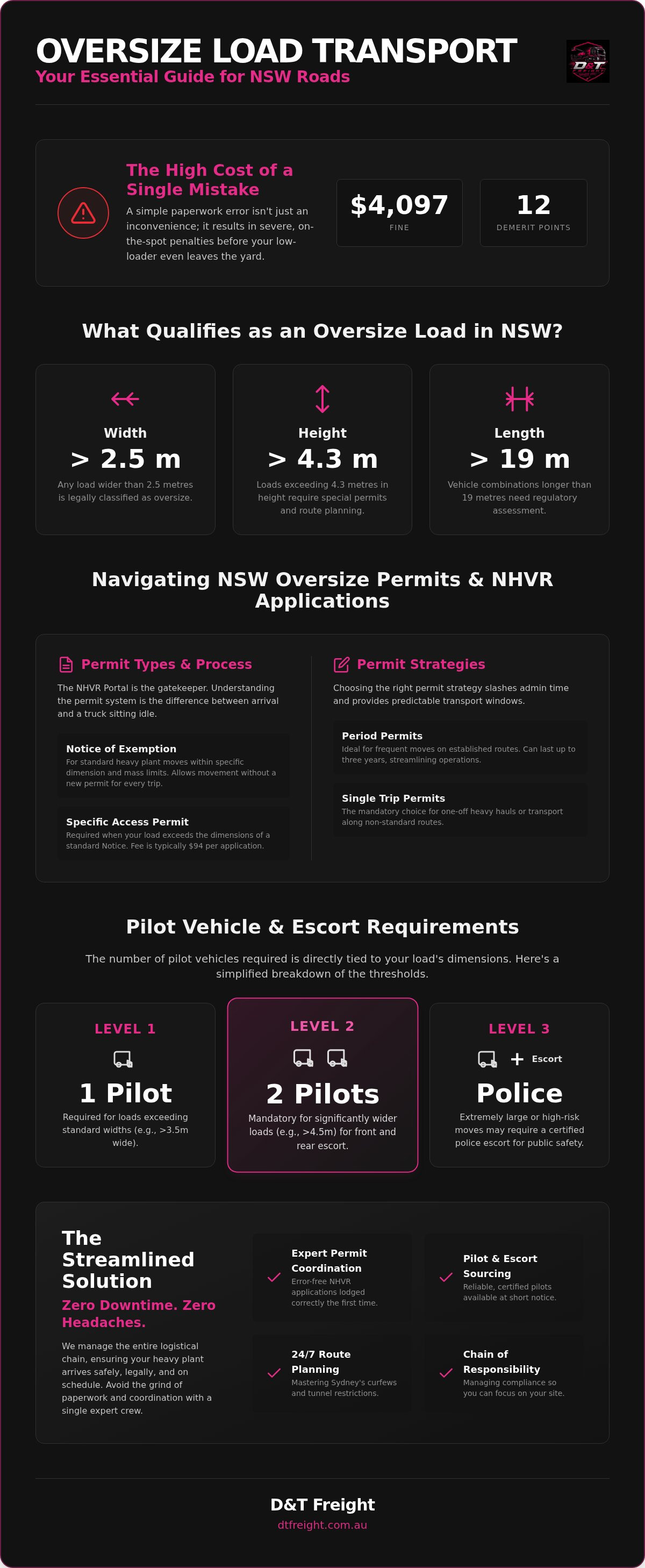
A single paperwork error can cost you $4,097 in on-the-spot fines and 12 demerit points before your low-loader even leaves the yard. In the high-stakes world of oversize load transport NSW, "near enough" is never good enough. You're dealing with shifting NHVR regulations, strict metropolitan curfews, and the constant struggle to find reliable pilot vehicles at short notice. It's a logistical grind that can stall a project and blow your budget before the first bucket hits the dirt.
We understand the pressure of a zero-downtime site. You need results, not excuses. This guide simplifies the complex. We'll walk you through the current permit landscape, the 2026 NSW curfew restrictions, and the specific pilot vehicle thresholds you must meet for a legal move. You will learn how to navigate Transport Management Plans and manage the Chain of Responsibility without the usual headaches. It's about getting your heavy plant to the site safely, legally, and on schedule. Let's get to work.
Key Takeaways
- Identify the exact width, height, and length dimensions that trigger oversize status in NSW to avoid heavy fines and demerit points.
- Navigate the NHVR permit application process efficiently and understand when you can operate under a standard notice versus a specific access permit.
- Determine exactly how many pilot vehicles your move requires based on current width and length thresholds for oversize load transport nsw.
- Master Sydney's complex curfew and tunnel restrictions to ensure your heavy plant arrives on site without costly site downtime.
- Streamline your logistics by coordinating permits, pilots, and 24/7 dispatch through a single expert crew that understands the high stakes of heavy haulage.
What Qualifies as an Oversize Load in NSW?
If your gear hangs over the edge of a standard trailer, you're in OSOM territory. It's that simple. In New South Wales, the rules are rigid. Managing the complexities of oversize load transport nsw starts with the tape measure. Any load exceeding 2.5 metres in width or 4.3 metres in height is legally classified as oversize. Length limits vary by vehicle type, but generally, anything over 19 metres requires a closer look at the regulations. These aren't just suggestions. They are the thresholds that determine whether you need a permit, a pilot, or a total route overhaul.
An Oversize load in NSW often involves heavy plant that simply cannot be shrunk. We're talking about 30-tonne excavators, wide-track graders, and articulated boom lifts. These machines are the lifeblood of your site, but they are logistical giants on the road. To move them, the industry relies on Class 1 load-carrying vehicles. These purpose-built combinations are designed to spread weight and manage dimensions that would crush or crown a standard freight trailer.
Class 1 Heavy Vehicle Categories
The Heavy Vehicle National Law (HVNL) is the rulebook. Under this law, Class 1 covers vehicles specifically designed to carry large, indivisible items. Your low-loader and tilt-tray combinations live here. It's vital to know the difference between 'oversize' and 'overmass'. Oversize is about the physical space you occupy. Overmass is about the pressure you put on the tarmac and bridges. Most heavy plant moves are both. A low-loader doesn't just provide the clearance for a tall excavator; it uses multiple axles to stay within the allowable ground pressure. If you're over 2.5 metres wide, you're oversize. If you're over the standard axle mass limits, you're overmass. You need to account for both before the key turns in the ignition.
Indivisible Items vs. General Freight
You can't just "break down" a machine to avoid a permit. The law is specific about indivisible loads. An indivisible item is one that cannot be divided without extreme effort or risk of damage. You can't be expected to strip an excavator to its bare chassis just to save a few centimetres. However, if you're carrying multiple smaller items that together exceed width limits, that's a breach. That's general freight, and the NHVR won't give you a pass on it. Class 1 vehicles are the backbone of oversize load transport nsw operations because they are legally recognised as the only way to move these "all-in-one" giants. Disassembly is often a false economy. The hours spent in the workshop and the risk of hydraulic contamination usually outweigh the cost of a proper OSOM setup. We focus on moving the machine as it stands, safely and legally.
Navigating NSW Oversize Permits and NHVR Applications
The National Heavy Vehicle Regulator (NHVR) is the gatekeeper of your schedule. In New South Wales, they manage the access permits that dictate exactly where and when your machinery moves. If you are organising oversize load transport nsw, you cannot afford to treat the NHVR Portal as an afterthought. It is the difference between a machine arriving on site and a truck sitting idle in a siding. The NHVR isn't your enemy, but their portal is unforgiving. One wrong digit on an axle spacing or a missed weight threshold and your application hits the bottom of the pile.
Most standard heavy plant moves operate under a "Notice," such as the Multi-State Class 1 Load Carrying Vehicle Dimension Exemption. These are standing rules that allow movement without a fresh permit for every trip, provided you stay within specific limits. However, once you exceed those dimensions, you need a specific Access Permit. As of August 2026, the application fee for a Class 1 or 3 permit is $94. It is a small fee, but the real cost is the time lost to red tape. We take the lead on oversize permit coordination to ensure your paperwork is lodged correctly the first time.
Types of OSOM Permits in NSW
Period permits are the smart play for frequent moves on established routes. They can last up to three years, slashing your admin load and providing predictable windows for transport. For one-off heavy hauls or non-standard routes, a single trip permit is the requirement. 2026 also sees the rollout of the Heavy Vehicle Smart Approvals and Permits System (HVSAPS). This system aims to automate approvals for high-risk routes using pre-approved data. While it speeds up the process, the initial data entry must be flawless to trigger an automated response. We track these legislative shifts so your gear keeps moving while others are still reading the updates.
The Transport Management Plan (TMP) Essentials
A TMP is a high-stakes tactical document. It is mandatory for any OSOM movement classified as "High Risk" due to its size, weight, or the sensitivity of the route. If your load is exceptionally wide or you are traversing a "Critical" corridor, the NHVR will not move without a TMP. This process involves:
- Route Assessments: Identifying every bridge height, narrow culvert, and overhead wire on the path.
- RIM Coordination: Negotiating with Rail Infrastructure Managers for safe passage over level crossings.
- Stakeholder Management: Notifying local councils and police if traffic diversions are required.
Pilot Vehicles and Escorts: Safety Requirements for NSW Roads
Safety on the road isn't a suggestion. It is a legal mandate. When managing oversize load transport nsw, pilot vehicles are your primary defence against road incidents and massive fines. You don't just follow the truck. You clear the way. The NHVR and Transport for NSW set clear thresholds for when these vehicles are required. If your load is wider than 3.5 metres or longer than 26 metres, you need at least one pilot. Cross the 4.6-metre width or 30-metre length mark, and you are looking at two pilots. For the massive gear, wider than 5.5 metres or longer than 35 metres, three pilot vehicles are the baseline.
Professional coordination prevents site delays. Along the high-traffic East Coast corridor, especially the run from Sydney to Melbourne or Queensland, the margins for error are zero. Traffic is heavy. Roads are narrow. A pilot vehicle is an active traffic management tool, not just a ute with a flashing light. They provide the lead time needed to clear narrow bridges and manage tight urban corners before the heavy haulage combination arrives. We coordinate these teams to ensure seamless movement across state lines, keeping your project on track and your liability low.
Pilot Vehicle Responsibilities
A pilot's job starts before the wheels turn. They manage the radio. They warn oncoming traffic. They scout for immediate hazards like fresh roadworks or unmapped breakdowns. On narrow bridge crossings, the lead pilot stops traffic to ensure the load has the entire span. Communication is constant. The truck driver and pilot stay on the UHF, calling out hazards and clearing every kilometre. Every pilot vehicle must carry compliant "Oversize Load Ahead" signage, high-intensity rotating lights, and flags. We ensure every pilot in our network meets these standards. Your move stays legal. Your gear stays intact.
Police Escort Triggers
High-risk moves require "blue lights." In NSW, once a load hits 6 metres in width or 45 metres in length, NSW Police escorts become mandatory. Booking these escorts is a major logistical hurdle. You are dealing with limited police availability and strict lead times. If you miss your window, your machine sits in the yard. We handle the coordination with local area commands and the Highway Patrol. We sync the police schedule with our 24/7 dispatch to ensure a clear run. Precision is everything. We manage the authorities so you can focus on the site. High-risk oversize load transport nsw requires expert timing. We don't leave that to chance.
Route Planning and 24/7 Dispatch: Beating the Curfews
Curfews are the hard reality of oversize load transport nsw. You can't just roll onto the M4 at 8:00 AM with a five-metre wide excavator. Sydney's road network is a labyrinth of time-based restrictions designed to keep peak-hour traffic moving. If you miss your window, your machine sits in a bay for hours, burning money and stalling your site crew. We don't let that happen. Managing the East Coast corridor, from Sydney down to Melbourne or up into Queensland, requires a tactical approach to timing. You need to know exactly when the gates open and when they slam shut.
Public holidays and long weekends add another layer of complexity. During periods like Easter or the Christmas-New Year break, OSOM movements face significant travel bans. These aren't just for the city; they extend to popular regional routes where holiday traffic peaks. We track these NSW curfew times with surgical precision. If a move is blocked on a Friday afternoon, we're ready to go the moment the restriction lifts. Our 24/7 dispatch services ensure that your machinery moves the second it's legal to do so, bypassing the congestion that slows down less agile operators.
Night Dispatch and Traffic Avoidance
Night moves are often the only way to get the job done. They are faster, safer, and involve fewer civilian vehicles on the road. Meeting "Night time travel" conditions often allows for wider loads that would be prohibited during the day. D&T Freight operates 24/7 to solve site emergencies. If a machine breaks down at 2:00 AM and you need a replacement on site by sunrise, we have the crew and the gear ready to move. We don't wait for office hours. We move when the roads are clear and the site is waiting.
NSW Motorway and Tunnel Access
Sydney's tunnels are notorious for height and width traps. In 2022, 45 over-height trucks were detected in the Sydney Harbour Tunnel alone. That was almost double the number from 2021. The fines are massive, and the traffic chaos is worse. We plan for the M4, M7, and NorthConnex clearances, but we always have a Plan B. If a load is too high for the tunnel, we map the surface route. This "last mile" planning is where most transport jobs fail. We assess the final turn into your job site to ensure the low-loader doesn't bottom out or get wedged on a tight suburban corner. We get the plant to the dirt, not just the front gate.
Reliable Heavy Haulage: Why D&T Freight is the Site Manager's Choice
Site managers don't have time for excuses. When a project is behind schedule, every hour a machine sits in a yard is a hit to your bottom line. You need a partner who understands the high stakes of oversize load transport nsw. We aren't just a transport company. We are a tactical extension of your crew. We take a no-nonsense approach to heavy haulage. We don't just provide the trailer; we manage the entire lifecycle of the move. This includes permit coordination, pilot vehicle scheduling, and precise route planning. We've moved the gear that builds the state. Excavators, graders, and boom lifts. We know the equipment, we know the roads, and we know how to get results.
Reliability in this industry is built on constant availability. We operate with a "get it done" attitude that mirrors the industrial nature of your site. If a logistical problem arises, we solve it. We don't linger on abstract promises. We focus on the physical movement of your plant. Our team handles the difficult details so your operators can stay on the tools. From the moment you call until the machine is off the low-loader, we are in control. It's about rugged reliability and operational confidence.
The 15-Day Credit Advantage
Construction runs on cash flow. We know that paying for every individual transport job upfront is an administrative burden and a financial drag. To support our regular contractors, we offer a 15-day credit account. The application process is straightforward. Once approved, you can focus on the job, not the paperwork. This financial flexibility allows you to book oversize load transport nsw as the site requires, ensuring zero downtime while your accounts team processes the cycle. It is a pragmatic solution for a fast-paced industry.
East Coast Coverage and 24/7 Availability
Your site doesn't sleep, and neither do we. Our 24/7 dispatch services mean we are ready to move gear on weekends, nights, and public holidays. We cover the entire East Coast corridor. Whether you are moving a grader to regional NSW or shifting a fleet interstate to Melbourne or Queensland, we have the reach. We manage the curfews, the pilots, and the permits across every border. We are the fixer who is always awake and ready to move. Don't let logistics stall your progress. Get a no-nonsense quote for your oversize load today and get your gear to the dirt without the headaches.
Get Your Heavy Plant to Site Without the Drama
Managing oversize load transport nsw doesn't have to be a logistical nightmare. It starts with precise dimension checks and ends with a machine safely on the dirt. You now know the thresholds for mandatory pilot vehicles and the critical importance of mastering Sydney's motorway curfews to avoid costly site downtime. The red tape is thick, but it's manageable with a crew that knows the NHVR portal inside out. Precision in the planning phase prevents chaos on the road.
We are the specialists in excavator and heavy plant transport who never sleep. Our 24/7 dispatch and delivery service ensures your gear moves when the roads are clear, not just when the office is open. With 15-day credit accounts available for regular contractors, we prioritise your cash flow as much as your schedule. We handle the permits, coordinate the pilots, and manage the authorities so you can focus on the build. The gear is ready. The route is planned. Let's get to work.
Book your oversize load transport with the NSW experts and keep your site moving forward.
Frequently Asked Questions
What is considered an oversize load in NSW?
A load is classified as oversize in New South Wales if it exceeds 2.5 metres in width, 4.3 metres in height, or the specific length limit for the vehicle type. These thresholds trigger the need for specific oversize load transport nsw regulations, including potential permits and pilot vehicles. You must measure the total combination, including any overhang, to ensure you aren't breaching standard dimensions.
How long does it take to get an NHVR oversize permit?
Permit processing times vary based on the complexity of the route and whether local council consent is required. While some standard notices allow immediate travel, a specific access permit through the NHVR portal can take anywhere from a few days to several weeks. We manage the coordination to ensure your application is lodged correctly the first time, avoiding unnecessary back and forth delays.
Do I need a pilot vehicle for a 3.5-metre-wide load?
You are legally required to have one pilot vehicle for any load wider than 3.5 metres or longer than 26 metres. If your load exceeds 4.6 metres in width, the requirement increases to two pilot vehicles. We arrange these pilots as part of our comprehensive transport service to ensure your move stays compliant and safe on the road.
Are there curfews for oversize transport in Sydney?
Strict curfews apply to oversize vehicles on Sydney's major motorways and in tunnel networks to prevent peak hour congestion. Most OSOM movements are prohibited during morning and afternoon peak periods; some high risk loads are restricted to night time travel only. We plan your route around these windows to ensure the low-loader doesn't get stuck in traffic or face heavy fines.
Can I move heavy machinery on weekends in NSW?
Weekend movement is permitted for many oversize loads, but specific curfews and restrictions often apply in urban areas and on major regional corridors. Significant travel bans are usually in place during public holiday periods like Easter and Christmas to manage increased civilian traffic. We check the current 2026 NSW curfew times for every job to confirm your gear can move legally.
What information do I need for a Transport Management Plan (TMP)?
A TMP requires precise machine dimensions, total combination mass, detailed route assessments, and coordination with infrastructure managers like rail authorities. You must identify any high risk areas, such as low bridges or narrow culverts, and outline how traffic will be managed. We handle the heavy lifting on these documents, building the plan and securing the necessary approvals for your move.
Does D&T Freight handle interstate oversize transport?
We provide full heavy haulage services across the East Coast, including regular runs between Sydney, Melbourne, and Queensland. Our team manages the different state-based regulations and permit requirements to ensure a seamless oversize load transport nsw move across borders. We operate 24/7 to keep your machinery moving regardless of the distance.
How do I apply for a 15-day credit account with D&T Freight?
You can apply for a 15-day credit account by contacting our dispatch team directly to start the simple application process. This facility is designed for regular contractors and site managers who need to maintain steady cash flow while moving heavy plant. Once approved, you can book transport and manage your project without the need for immediate upfront payments for every trip.

