
A site manager's worst nightmare isn't a machinery breakdown. It's a 40-tonne excavator sitting idle at 4:00 PM on a Friday because a permit didn't clear or a driver went MIA. You've likely felt the sting of hidden costs or the stress of heavy equipment transport failing at the final hurdle. It's a logistical minefield where one oversight can blow your budget and your timeline.
We understand that moving plant is about more than just hauling metal from A to B. It's about precision, compliance, and keeping the project moving. This guide is your no-nonsense manual for mastering the logistics of heavy haulage. We'll show you how to navigate the August 2026 Heavy Vehicle National Law amendments and manage the Chain of Responsibility without losing your head.
You'll learn the essentials of site prep, how to coordinate OSOM permits through the NHVR portal, and the exact pilot vehicle requirements for loads over 3.5 metres. We're breaking down the complex steps into a clear, actionable plan to ensure zero-incident transport, on-time delivery, and simple credit-based billing. Let's get your gear moving.
Key Takeaways
- Match your machinery to the right trailer, using low loaders for heavy plant and tilt trays for rapid gear deployment.
- Streamline your heavy equipment transport by mastering NHVR permit triggers and NSW pilot vehicle requirements for oversize loads.
- Prevent costly site delays by auditing access paths and ground load-bearing capacity before the transport crew arrives.
- Leverage 24/7 dispatch to move gear during off-peak hours or weekends, ensuring your project stays on schedule without Sydney traffic delays.
- Reduce administrative friction with 15-day credit accounts designed to keep site operations moving and paperwork to a minimum.
What is Heavy Equipment Transport and Why it Matters for Your Site
Heavy equipment transport is the specialised relocation of heavy plant and industrial machinery. We're talking about massive gear. Excavators, graders, rollers, and boom lifts. It requires purpose-built trailers and a deep understanding of load dynamics. Standard freight services cannot handle this work. They lack the weight capacity and the technical knowledge for over-dimensional loads. If you try to squeeze a 20-tonne machine onto a standard flatbed, you're asking for a disaster. Safety regulations and weight limits are there for a reason. Breaking them isn't an option.
Site managers carry the weight of the schedule. You coordinate the movement to avoid project downtime. If the machine isn't there, the crew isn't working. It's that simple. Understanding what is a heavy hauler is the first step in identifying the right partner for the job. You need a team that speaks the language of the site and understands the pressure of a deadline. Heavy equipment transport is a precision operation, not just a towing job.
The High Stakes of Heavy Haulage
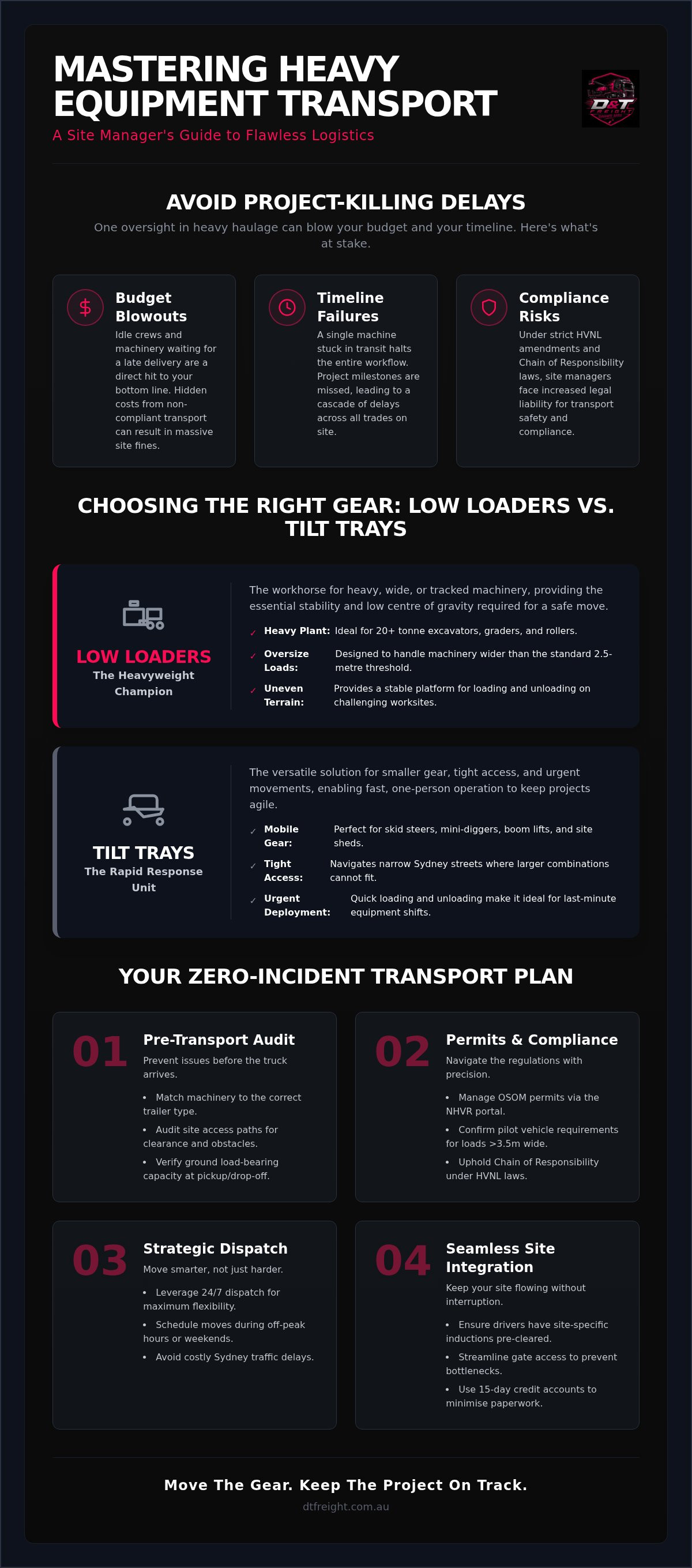
The cost of a delay is more than just a line item. It's a project killer. One machine stuck in transit halts the entire workflow. Imagine a crew of ten standing around because the grader didn't show. That's thousands of dollars wasted in a single afternoon. Safety and compliance are the backbone of the operation. You must meet Australian standards for load restraint every single time. Under the August 2026 HVNL amendments, the Chain of Responsibility laws have tightened. Site managers now face increased legal responsibility for transport safety management. Going with the "cheap" option is a gamble you can't afford to take. A low-ball quote often means cut corners, which leads to massive site fines and failed safety audits. Don't risk it.
Key Components of a Successful Move
Precision starts before the truck arrives. You have to match the right trailer to the machine weight. A low loader is the workhorse for 20-tonne excavators, while a tilt tray is perfect for rapid boom lift deployment. Get the gear wrong, and the move stops before it starts. Every minute at the site gate counts. Ensure the driver has all site-specific inductions ready to go. It prevents bottlenecks and keeps the site flowing. Finally, verify the basics. Check insurance and public liability documents before the gear leaves the ground. It's about rugged reliability. You want the peace of mind that comes from a logistical problem solved through efficiency and constant availability. Move the gear. Keep the project on track. Get it done.
Choosing the Right Gear: Low Loaders vs Tilt Trays
Selecting the wrong gear for heavy equipment transport is a fast way to blow your budget. You need the right tool for the specific machine. It isn't just about weight. It's about dimensions, site access, and loading speed. Low loaders and tilt trays are the backbone of the industry, but they serve very different purposes. Getting the match wrong leads to delays at the gate and safety risks on the road.
Height is the primary enemy of heavy haulage. If your load is Out of Gauge (OOG), deck height is everything. Low loaders sit significantly lower than standard trailers. This gives you the clearance needed for Sydney's bridges and low-hanging wires. If your machine is non-operational, winch capacity becomes the priority. A winch that can't handle the dead-weight of a 20-tonne excavator is a liability. We ensure the gear matches the reality of the machine before the truck even leaves the yard.
When to Hire a Low Loader
Heavy, tracked machinery requires a low centre of gravity. A 20-tonne excavator or a large grader needs the stability that only a low loader provides. These trailers are designed to handle loads wider than the standard 2.5-metre threshold. They offer the structural integrity to support concentrated weight over the axles. Loading on uneven site terrain is dangerous without the right footprint. Low loaders provide a stable platform for the machine to crawl up the ramps. It's about safety and rugged reliability. No shortcuts.
The Versatility of Tilt Tray Trucks
Tilt trays are the rapid-response unit of the fleet. They're ideal for smaller gear like skid steers, mini-diggers, and boom lifts. If you need a site shed moved by tomorrow morning, a tilt tray is the answer. They shine in tight Sydney street locations where a full float combination simply won't fit. The hydraulic tray slides back and tilts, allowing the machine to drive or be winched directly onto the bed. It's a fast, one-man operation. This makes them the go-to for last-minute equipment shifts that keep the project moving.
Matching the machinery to the trailer prevents site bottlenecks. If you're looking to book reliable machinery transport, you need a crew that knows the difference between a simple move and a complex recovery. We handle the technical details so you can focus on the build. Every minute saved in loading is a minute gained on the project timeline. We move fast, but we move correctly.
Navigating Oversize Permits and Pilot Vehicles in NSW
NSW roads aren't a free-for-all. Once your load exceeds 2.5 metres in width or 4.3 metres in height, you're officially in oversize territory. This is where heavy equipment transport becomes a legal tactical exercise. The National Heavy Vehicle Regulator (NHVR) is the gatekeeper. You don't just load up and drive. You need the right permits, the right route, and the right escort. Under the August 2026 Heavy Vehicle National Law amendments, the responsibility for safety management sits squarely on the shoulders of everyone in the chain. That includes you.
Route planning in Sydney is a headache you don't want. You have to dodge low bridges, avoid weight-restricted suburban streets, and account for tunnel clearances. One wrong turn into a restricted zone results in more than just a fine. It results in a grounded machine and a halted project. We map every move to ensure the path is clear before the key hits the ignition. It’s about precision and rugged reliability.
The Permit Application Process
Lead times are the project killer. You can't apply on Thursday and expect to move on Friday. High-risk movements, such as loads exceeding 40 metres in length, require a detailed Transport Management Plan (TMP). This involves route surveys and stakeholder consultations that take time. To get a permit across the line, you need exact data. Dimensions. Total mass. Axle loads. D&T Freight handles the heavy lifting here. We manage the NHVR portal and coordinate the paperwork so you can focus on the site. We turn a complex regulatory hurdle into a solved problem.
Pilot Vehicle Requirements
Pilot vehicles aren't optional extras. They are legal requirements for public safety. In NSW, the rules are clear. A load wider than 3.5 metres or longer than 26 metres requires one pilot vehicle. If you hit 4.6 metres wide or 30 metres long, you need two pilots. Once you reach 5.5 metres wide, you're looking at three. If your gear is 6 metres wide or 45 metres long, you'll need a police escort. Managing these logistics is part of the job. Night moves through Sydney often require additional escorting to navigate arterial roads safely. We coordinate the entire crew. Pilots, drivers, and site teams. All working in sync to get the gear delivered without a hitch. Move the machine. Protect the public. Get it done.
Site Preparation: A Checklist for Safe Pick-up and Drop-off
Your transport crew is only as good as the site you provide. If the truck can't reach the machine, the job stops. Heavy equipment transport depends on the "last mile" being as prepared as the highway. A loaded float isn't just heavy; it's a massive physical footprint that requires firm ground and clear space. Don't wait for the driver to arrive before you check the path. Do it now. Every minute the driver spends clearing your site is a minute added to your invoice.
Ground conditions are non-negotiable. You must verify that the surface can support the weight of a fully loaded trailer. Soft mud or uncompacted fill will swallow a truck, leading to recovery costs that dwarf the original transport fee. Prepare the machine properly before the truck pulls in. Clean the tracks to prevent mud and rocks from flying off on the road. Secure every loose attachment. These are simple, rugged steps that prevent major insurance headaches and keep the public safe during transit.
Ensuring Site Access in Sydney
Sydney sites present unique challenges. Overhead obstructions like low-hanging power lines or thick branches can halt a move instantly. You need to scout the entry point for height and width. If you're loading on a public road, traffic control isn't a suggestion; it's a legal requirement. You must allocate enough space for the trailer to manoeuvre and turn. A standard low loader needs significant room to swing. If you haven't cleared the site gate or moved the parked utes, you're burning daylight and money. Ensure the path is clear from the kerb to the machine.
The Pre-Start Safety Check
Safety is a shared burden under the August 2026 HVNL amendments. Before the driver touches the controls, confirm the machine is in a "safe to transport" state. Check for hydraulic leaks or mechanical issues. A machine that won't start or won't hold pressure becomes a recovery job, not a transport job. Brief the driver on site-specific hazards before they enter the site. Power lines, hidden pits, or steep gradients. Documentation must be ready. Have your site inductions and hire agreements on hand to avoid bottlenecks at the gate. This keeps the driver moving and your site compliant. If you need a team that understands site reality, organise your machinery move with a crew that values precision. We don't just haul; we solve the logistical puzzle for you.
Why 24/7 Dispatch is Critical for Sydney Projects
Sydney's road network doesn't sleep, but it definitely slows down. Trying to move a 20-tonne excavator through the M4 or M5 during peak hour is a recipe for disaster. It's a waste of fuel, time, and money. This is why 24/7 dispatch is the backbone of effective heavy equipment transport. You need the flexibility to move when the roads are clear. Night-time moves aren't just about speed. They're about safety. Fewer cars on the road mean lower risks for your load and the public. With heavy vehicle registration charges increasing by 3% for the 2026-27 period, every litre of fuel saved by avoiding gridlock matters to your bottom line.
Project deadlines don't care about business hours. If a machine goes down on a Saturday afternoon, you can't wait until Monday morning to call for a float. Weekend transport allows you to shuffle gear while the site is quiet. You hit those Monday morning milestones without the Friday afternoon stress. We operate on your schedule, not the other way around. Emergency breakdowns require a "get it done" attitude. We provide the rapid dispatch needed to keep your site from grinding to a halt. When the pressure is on, you need a partner who answers the phone at 3 AM. No corporate fluff. Just results.
Night Dispatch and Route Efficiency
Moving gear at 2 AM is the ultimate efficiency hack. The traffic risks are minimal. The route is clear. This is particularly vital for OOG loads that require pilot vehicles and specific lane clearances. We coordinate directly with your site security for after-hours access. No one likes a bottleneck at the gate at 3 AM. Our commitment to 24/7 operational support means we're awake when you are. We handle the logistics of the move while you manage the site. It's a partnership built on rugged reliability. We know the shortcuts that avoid low bridges and the arterial roads that stay open when others are under maintenance.
Streamlining Admin with Credit Accounts
Cash flow is the lifeblood of any construction project. Managing multiple invoices for every equipment shift is a paperwork nightmare. We solve this with 15-day credit accounts for our regulars. It simplifies the booking process and reduces the administrative burden on busy site managers. You get the gear moved when you need it. You pay on terms that suit your project's cash flow. It’s about making the logistical side of your job as simple as possible. No more chasing approvals for every single move. Apply for a 15-day credit account with D&T Freight to streamline your next machinery move. We move the heavy stuff so you can focus on the build.
Keep Your Project on Track with Precision Haulage
Effective heavy equipment transport isn't just about moving iron. It's about matching the right low loader to your machine and prepping your site to avoid costly bottlenecks. You've seen how navigating NHVR permits and managing pilot vehicles in NSW requires more than just a truck; it requires a tactical plan. Don't let a missing permit or a soft ground surface halt your progress. One mistake on the road or at the gate can derail an entire project timeline. Precision is the only way forward.
We're the expert crew that handles the difficult details. From 24/7 dispatch that beats the Sydney peak hour to 15-day credit accounts that keep your cash flow steady, we're built for the industrial reality of your site. We specialise in oversize permits so you don't have to worry about the paperwork. The gear is ready. The drivers are inducted. No corporate fluff. Just rugged reliability and a commitment to getting the job done right the first time. We solve the logistical problems so you can focus on the build.
Get a No-Nonsense Quote for Your Heavy Transport Today and keep your project moving toward the finish line. We're ready to move when you are.
Frequently Asked Questions
How much does it cost to transport heavy machinery in Sydney?
Rates depend on the machine's weight, its dimensions, and the specific route. Heavy haulage isn't a fixed-price commodity because every job has different permit and pilot vehicle requirements. Short runs within Sydney often involve minimum call-out fees and hourly rates. Long-distance moves are typically calculated per kilometre. We provide firm quotes based on your specific machinery and site locations to ensure there are no hidden costs.
Do I need a permit for every heavy equipment move in NSW?
No, you only need a permit if your load exceeds standard legal dimensions or mass limits. A load is generally considered oversize in NSW if it's wider than 2.5 metres or higher than 4.3 metres. If your gear fits within these limits and doesn't exceed axle weight thresholds, it's a standard move. For everything else, we coordinate the NHVR permits to keep you compliant with 2026 safety standards.
What is the difference between a low loader and a float?
Industry professionals often use these terms interchangeably, but they have technical differences. A float is a general term for any trailer designed to carry heavy plant. A low loader is a specific type of float with a deck that sits very close to the ground. This low profile is essential for tall machines to clear Sydney's bridges and wires. We select the right float based on your machine's specific height and weight.
How much notice do I need to give for an oversize load transport?
Give us as much lead time as possible, ideally at least a week for standard oversize moves. Complex heavy equipment transport requiring a Transport Management Plan or police escorts can take significantly longer for NHVR approval. Early booking ensures we can secure the necessary pilot vehicles. For gear within legal dimensions, our 24/7 dispatch can often move much faster to meet your site deadlines.
Can you move machinery on weekends or public holidays?
Yes, we operate 24/7 to suit your project schedule. Weekend moves are often the best way to avoid Sydney traffic and ensure gear is ready for a Monday morning start. Some oversize permits have curfew restrictions that prevent travel during holiday periods or peak times. We check these restrictions during the planning phase to ensure your machine doesn't get stuck at the roadside during a holiday curfew.
What information do I need to provide for a heavy haulage quote?
We need the make and model of the machine, its exact weight, and its dimensions. Don't guess the width or height. An extra 10 centimetres can change the permit requirements and cost. Provide the exact pick-up and drop-off addresses. Tell us if the machine is non-running so we can send a truck with a winch. Accurate data prevents bottlenecks and ensure we send the right gear for the job.
Who is responsible for securing the load on the trailer?
The driver is responsible for the physical restraint, but the legal burden is shared under Chain of Responsibility laws. You must ensure the machine is in a safe state for transport before we arrive. Our drivers use heavy-duty chains and binders that meet Australian load restraint standards. Safety is our priority. We don't move the truck until the load is fully secured and checked.
What happens if the machine breaks down during loading?
We pivot to a recovery operation. If the machine won't walk onto the trailer, we use high-capacity winches to pull it up. This requires a truck specifically equipped for non-runners. Tell us about mechanical issues or hydraulic leaks before we arrive. It is the difference between a standard move and a complex recovery. We have the gear to handle dead machines, but we need to know first to send the right crew.
